Showing posts with label Energy. Show all posts

Tuesday, February 15, 2011

Net-Zero Energy Building

An article from the NY Times yesterday about a net-zero building and how it operates. Pretty interesting. One of the interesting things to me was how they wanted existing "off-the shelf technology", not anything particularly innovative, just conscious construction. They also talked about how some of these differences have also influenced human behavior in the office.

Soaking Up the Sun to Squeeze Bills to Zero

By KIRK JOHNSON
Published: February 14, 2011
http://www.nytimes.com/2011/02/15/science/15building.html?nl=todaysheadlines&emc=tha210

Thursday, February 10, 2011

Comments on Kalamazoo College Infrastructure


Roxanne Walker
After seeing the centralized heating and cooling systems for campus, I wonder what the motivation was for centralizing those systems. Presumably the networks are more efficient than having individual heating and cooling systems in each building. How much heat is lost as steam is piped up campus to heat the farthest buildings? Another factor is maintenance. Does it require more resources (materials, time, and human resource) to keep a dozen small heating and cooling systems running, or to maintain the complex of pipes that comprise the networked system? I was impressed by the method of freezing water during the night, when energy is relatively cheap, and using it to run the cooling system during the hot, peak hours. I wonder how much energy is saved (in addition to money) by cooling the water overnight, when the temperatures are lower. Is any energy lost in this process? I expected it to be intentional that the steam line passed under the sidewalk. Another thing I found a little confusing was that the LEED certification would require that much more documentation than straightforward building; shouldn’t those sort of details be laid out and planned in some form, anyway? If it’s just a matter of organizing the details, it’s unintuitive for a thorough outline of the building requirements to be only a third of the required documentation. What else to they require for LEED certification, and how much money do they make doing it? It’s all in a name.


Samuel T. Brennan
A few quick thoughts on the tour today. First off I thought Paul was great I am really glad you got him to speak to the class.

I also really enjoyed seeing both the heating and cooling center for some reason I thought they would be together, but it makes sense keeping them apart. I found it incredible that we are still using boilers from the 60's as well as the information about how energy cost more from between 11am to 7pm.

I did not know about that we may have to change the way we heat our house. I also am amazed at all the pipes running around campus, it would be really cool to see a x-ray of that. Overall I thought that was a really beneficial tour of how our campus utilizes energy and water.


Kari Larson

Well, I don’t really have anything to compare the bowels of our college’s heating and cooling systems to except my imagination. My only prior experience with what we saw today was when the sidewalks were torn up outside Severn when the steam line was getting repaired, so I guess I knew there was some large system somewhere but I never thought much of it and I think that goes for almost everyone at K. When I thought about it I guess I was expecting to see a cramped dingy room that was full of dust and cobwebs with some rusty pipes and a huge hot water heater. The tour certainly opened my eyes to the expanse of the heating and cooling system and all the energy it takes. I was incredibly impressed with how well labeled everything was and how clean it was. I could definitely tell that Paul and the college have taken the time to maintain the system, which seems to go hand in hand with trying to make the system as efficient as possible. I thought that it was interesting that not every building had there own systems, but Paul explained that it was easier for maintenance and also more cost effective and contained. I asked Adam why the system in Hicks was on the roof because I thought that because heat raises it would be more efficient to put the system in the basement but Adam explained that it’s much easier to build, run the piping and maintain the building and the system if it is on the roof. When I think of making a heating and cooling system I always assumed you would put it in the basement but apparently that is not always the most practical.

Adam Smith
I had seen much of what we looked at before, although I'd never been that deep in the boiler complex or seen the chillers before, so that was neat to do. I spent a bit of time on the tour ruminating about the
benefits of central heat, such as we have. Paul said one of the big advantages is the lower maintenance load, which makes sense to me. With the high efficiency of new boilers though, I think a lot of the efficiency gains that used to be an argument for district heating have lost effectiveness. On our campus you notice this in terms of Hicks being moved to its own heat supply and plans to install local boilers in Trow and Dewaters. The times that district heating is very efficient is when you can reclaim process heat that would need to be rejected anyways, which is what Paul was suggesting when he talked about tying into Western's power plant for our steam needs. That would be very exciting. Other local options for that are limited, as there is no industry near campus. The other thing I was thinking about is that I
want to look up what percentage of energy is actually used on air conditioning, as I expect it is a good bit higher than the 3-4% Paul suggested. The overall cooling load is much much lower than heating, but
cooling is 3+ less efficient than heating, so the total energy use may in fact be similar.


Christine Voss
Before our energy tour I had never really thought about how the campus was powered, how the water was heated, and how building were air-conditioned. At first I was really impressed with the magnitude of the system we have, especially the process to keep building air-conditioned. But, as we walked around the system’s large size made sense, as there are many, big buildings on campus. It also amazed me the underground tunnels, and I was really happy to finally learn why certain sidewalks were snow-free! Ultimately the tour made me a lot more conscious of the amount of energy we use on out small campus, and how much other larger businesses and schools are using. Every time I wash my hands under hot water, or enjoy the coolness of air conditioning I’ll be wondering about its source and thinking about the complicated and energy-using system that provides us with these luxuries. Thanks again to Mr. Manstrom for taking us on the tour; I really enjoyed learning more about our campus and energy sources in general.

Ada McCartney
Mr. Manstrom is wonderful, I am very excited for his class visit. I have never had the opportunity to see those inner workings of the college. I was especially interested in the tunnel that follows the boiler pipes around the campus--did I understand correctly that people can walk in there? The tour of Dow was incredible, I had no idea that a science building would require more energy than, say a library or a student center, but now that I think about it, that does make a lot of sense. I would be interested to see more of the campus water and energy components and talk more about collaboration with WMU and the city of Kalamazoo, I'm really fascinated by Oberlin and the initiatives there and am excited to read that document.

Saturday, February 5, 2011

Bridging Into Renewable Energy

The proposed bridge would harness solar energy through a grid of solar cells embedded in the road surface, while wind turbines integrated into the spaces between the bridge’s pillars would be used to generate electricity from the crosswinds. The solar highway would stretch 12.4 miles, with the bridge's wind turbines generating enough electricity to power 15,000 houses a year (or 115,000, according to GizMag...). It would also include panoramic viewing points and entirely self-sufficient solar greenhouses. Visitors to the park will be able to stop and buy the local produce grown in these greenhouses.


The Solar Wind bridge concept combines solar cells and wind turbines to generate power for...


The Solar Wind bridge concept combines solar cells and wind turbines to generate power for...


Gizmodo | New Italian Blood | GizMag

Thursday, February 3, 2011

TCLocal of Tompkins County, NY

http://tclocal.org/


Mission and Purpose of TCLocal

Some time in the next 30 years, life will start to become very different from what it is now. By mid-century we will use much less energy; we will live every aspect of our life much closer to home; and we will be much poorer in material terms, because energy and wealth are basically the same thing in an industrial society.

Energy descent — a radical reduction in our use of energy — is certain, but it’s not clear yet which of several factors will cause it to begin. Perhaps we will decide to do the right thing about climate change and reduce our CO2 emissions 80 or 90 percent, which would require changes almost that large in our actual consumption of energy. And there are other ways we might experience a radical reduction in our use of energy; for example, economic collapse, or an expanded war in the middle east. But the factor that makes energy descent a sure thing and sets the theme for this century is "peak oil" — the leveling off of global oil production and then its eventual and inexorable decline.

The timing of the peak is debatable, with forecasts ranging from 2005 (that is, already here) to 2030. But most credible estimates agree with the U.S. Army Corps of Engineers, which concluded in a recent study that "world oil production is at or near its peak," and with the director of research at OPEC, who said recently that "we are at, or near, the production peak of world oil, if not on the downward slope."

After the peak, the growing gap between falling world oil production and ever-increasing global demand will send prices skyward, with economic results that can only be imagined but will certainly include greatly restricted mobility due to the high cost of fuel and much higher prices for most goods, including food. The result will be less disposable income, a life lived closer to home, and a greater reliance on the goods and services that can be provided locally. Since the supply of oil and other fossil fuels is finite, this outcome is guaranteed. The only question is, Shall we plan for what we can see coming, or just let it happen to us?

A group of area citizens, TCLocal, has begun planning now. TCLocal contributors are committed to researching various aspects of energy descent in Tompkins County and writing up a preliminary plan for each aspect based on purely local challenges and resources. This is one such plan.

Who we are

Contributors to TCLocal are people living in and around Tompkins County, New York, who are committed to helping prepare for a future with less available energy. Specifically, each Contributor commits to researching and writing at least one article on a subject relating to our local response to energy descent. The pieces thus produced are published monthly on the tclocal.org web site in a format that enables members of the community to comment on the article and contribute to its eventual revision. There are also a few Contributors (such as the Editor) who provide services to the effort in lieu of articles.

How to contribute

Articles appearing at tclocal.org are published under the Creative Commons license and are owned and managed by the members of TCLocal as a group. People interested in becoming TCLocal Contributors should first read the Terms of Reference at  http://ibiblio.org/tcrp/process/terms.htm and then contact one of the TCLocal officers below to sign up.

Tom Shelley
Chair, TCLocal
tjs1@cornell.edu

Jon Bosak
Editor, TCLocal
bosak@ibiblio.org

Bethany Schroeder
Secretary, TCLocal
nidus@pinax.com

What to contribute

A list of topics so far identified can be found at  http://www.ibiblio.org/tcrp/process/outline.pdf
The topics listed are considered priorities, but the group will consider proposals to address any subject concerning local responses to energy descent.

Thursday, January 20, 2011

Seattle, Washington


by Ellen Bryna Smith
·     Ranked #3 overall in Sustainlane's 2008 Cities Sustainability Index
 ◦     #1 Rankings in three subcategories:

▪     City Innovation (Seattle satisfies all six categories):
·     environmentally preferable purchasing programs
·     city commercial green building incentives
◦     city recently increased new building efficiency standards by 30%
·     city residential green building incentives, carpooling coordination, car sharing programs (public or private)
◦     city does home energy audits (but they cost $95)
·     at least one other significant city innovation or program not accounted for in the other five areas

▪     Energy and climate change (Seattle satisfies all five categories)
·     City greenhouse gas tracking and carbon emission inventories
·     Carbon emission reduction goals
◦     Created the “Seattle Climate Action Plan” in 2006: a roadmap to achieve a carbon footprint 7 percent lower than 1990 levels by 2012.
◦     working to reduce vehicle emissions through promoting (and creating the infrastructure for) biking, walking, public transit (busses) and electric car use (charging stations); in the process of constructing a light rail system (to be complete in 2016)

·     Overall renewable energy use
◦     In 2006, 90 percent of Seattle's energy use came from renewable sources
·     Percentage for each city's alternative fueled vehicles as part of the total vehicle fleet was credited to cities with such fleets of greater than 12 percent of total fleet

·     Additional credit was given to cities that had formally signed onto the US Mayor's Climate Protection Agreement begun by Seattle Mayor Greg Nickels, had instituted significant, wide-ranging mitigation or adaptation programs, or had mounted significant city-wide planning efforts as of December 2007.

▪     Knowledge and Communications (Seattle satisfies all four categories):
·     Whether the city has an overall plan for sustainability
·     Whether it has a sustainability or environmental department that manages and tracks sustainability efforts across the city
·     Whether the city is working in collaboration with a major federal research laboratory or research university
·     Whether the city is working with a non-governmental organization across the city, rather than in only a single neighborhood
◦     Mayor created the Seattle Green Ribbon Commission in 2005; the commission included 18 leaders from Seattle's labor, business, academic, non-profit, and government communities to draft the city's Climate Action Plan
·     Green Buildings (Ranked #4)
◦     all new city buildings over 500 square feet must attain Silver LEED certification
◦     many private LEED-certified buildings throughout the city as well

Room for Improvement:
·     Housing Affordability (Ranked # 39)
·     Planning and Land Use (Ranked #25)

◦     City recently passed a “Parks and Green Space levy” which will allow the city to upgrade existing parks/green spaces and create new neighborhood parks/green spaces; the use of the money levied is directly monitored by a board of citizens

◦     Generally ranks moderately in sprawl rankings: ranked 44th most sprawling out of 83 in Smart Growth America's index; statistics indicate that the vast majority of Seattle's citizens commute into the city by car.

Personal observations from the last time I was in Seattle:
◦     noticed a LOT of LEED certified buildings
◦     made great use of space in order to incorporate green spaces into the city – ie, many green roofs/rooftop gardens; many parks, including much green space over the interstate
◦     biking was prevelant, but the city's very hilly topography makes cycling more challenging

Conclusions:
◦     Seattle is a leader in many aspects of ecological sustainability, especially regarding green buildings and energy innovations
◦     City's leadership is concerned with sustainability and wants to move city forward
◦     Issues of equity (ie housing affordability) seem to be Seattle's weakest points with regards to sustainability
◦     Seattle must come up with a way to better control its sprawl and implement “smart growth” policies.
◦     Seattle is moving in the right direction to becoming a sustainable city!

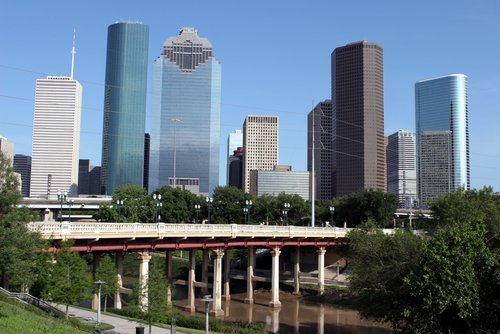
Cities: Houston, Texas


by Leigh Ann Ulrey 
·     Rated 36 overall on Sustainlane.com
o     11th in housing affordability
o     11th in green (LEED) certification
o     14th in Metro transit ridership
o     41st in air quality
o     44th in natural disaster risk

Houston is the energy capital of the nation; however, in July 2008 Houston was the leader in municipal purchaser of green energy (25% of energy was moved to wind power)

Energy Efficiency Incentive Program (EEIP)
o     An incentive program for commercial buildings to make energy efficient  upgrades to their buildings
 o     Part of an efficiency retrofit movement in the city

Residential Energy Efficiency Program (REEP)
o     Gives energy efficiency upgrades to low income homes

Other city efforts
o     All light fixtures were switched to energy efficient bulbs in city owned buildings
o     LEED certification is required for all construction on city owned buildings
o     Plans to continue to increase use of wind power
·     
Promoting the use of community electric cars
On-road vehicle remote sensing devices: can measure the exhaust emission from a car as they drive by the device and then light the number up on a screen a bit further down the road.
o     The city is giving gift funds to be used towards a new car for low income individuals with a car that does not meet code
SustainableHouston.org is a membership-based organizations that helps create networks of local businesses, famers and community organizations
o     They track and measure progress in four key areas of sustainability:
·     Fiscal Sustainability
·     Community Sustainability
·     Environmental Sustainability
·     Personnel Sustainability

·UrbanHarvest.org
o     An organization that works to educate and facilitate harvest and habitat gardens
o     Has helped start 130 community gardens
o     Created the first farmers market in the area since the depression
o     Has programs at 75 schools
·     
Biggest opposition is the city culture itself
o     "it seems that Houston is the most polluted and least eco-minded city in the United States"
o     "The majority of Houstonians believe that being concerned about the environment is a hippie, leftist or democratic ideal. It is not. This stigma is holding our city back."


Thursday, January 6, 2011

Quality of Life -- notes from Week 1 Thursday

Here are the notes we made on the board today regarding our ideas about our visions of what cities could be.

I'm posting them so that we can use this blog for continued dialogue.  So, add your comments and concerns regarding this list.

Also consider the questions about who decides what are cities are like and what our cities are for.  You might incorporate the readings in your comments.

access to good food and services
green space
walkable spaces
public space
community
public transit
trust
cleanliness
access to recreation
population control
safety -- police
communal thinking
share information -- transparency
schools, museums, heritage
regulations...."zoning"
infrastructure
chocolate factory
employment opportunities
wealth
know the people around you
diversity
community as the classroom
local economy + global economy
happiness
equity (i.e., access to good food, services)
quality for the world
dialogue
democracy -- republic
longevity